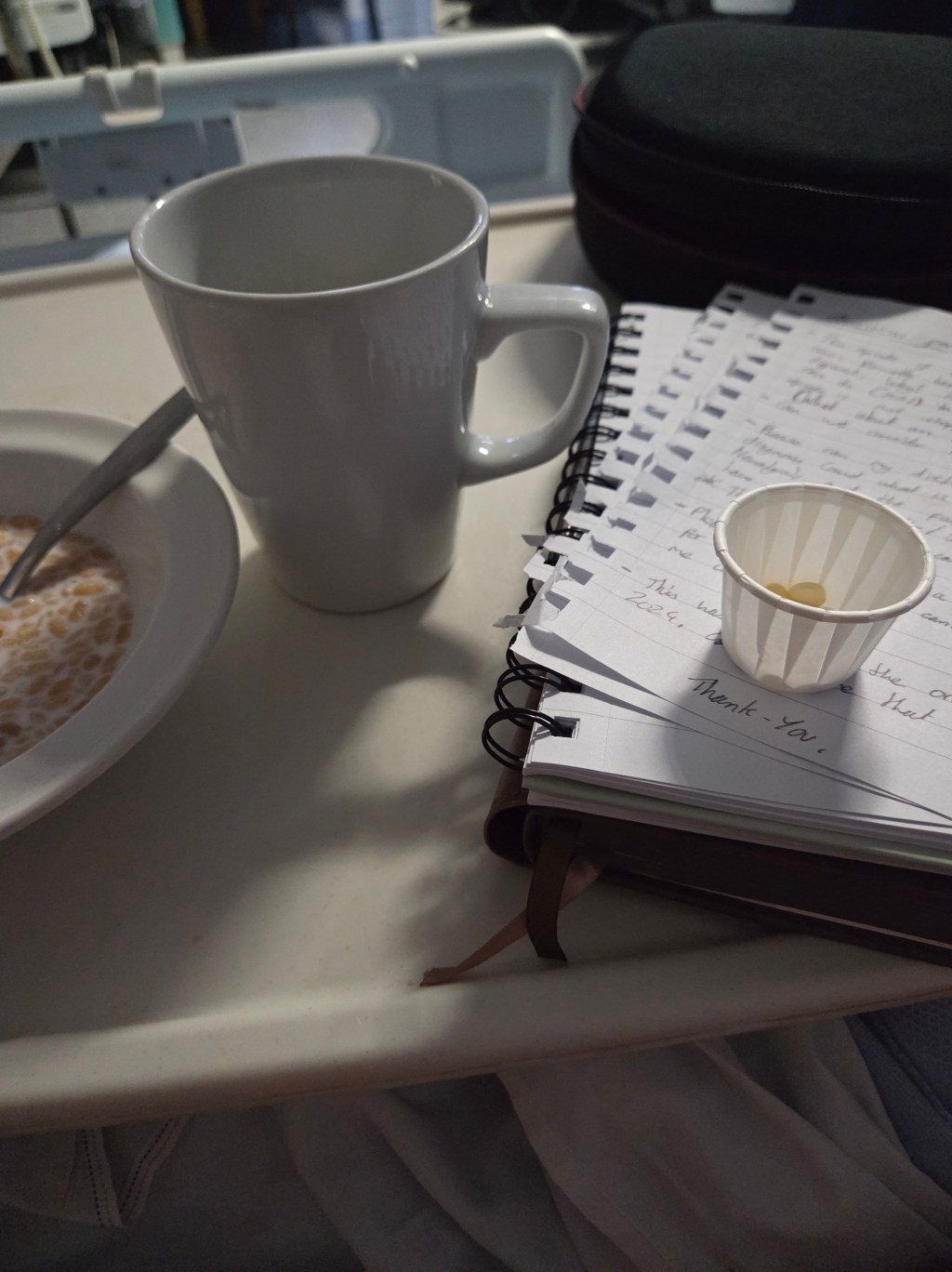
This is the final part of a very personal series. Grab a drink and settle in.
****
Part One: There’s Nothing We Can Do To Fix This
Part Four: Dr. Pain & The Ward of Strange Gentlemen
****
It’s been a while since I last wrote.
Christmas happened to all of us, and calling it chaotic would be generous.
It wasn’t all bad news, however, as there has been clinical progress on sorting my Trigeminal issues out. But, since I last wrote, my life has become appointment after appointment. Some days I swear I’ve attended an appointment solely so I can book the next appointment (wait, nope, this actually happened).
Still, there has been progress. Of sorts.
I am currently changing between medications again. I have had a very well qualified German doctor review my case, and a very well qualified English doctor review my case. France didn’t show up.
I am about to enter a tumultuous period again. Coming down from high doses of Gabapentin and then slowly moving up to high doses of Carbamazepine, well it’s an absolute treat for the body. Have a Google if you’re bored.
I also need to figure out a way to get back to work, but I’m coming to terms with the fact that I might not be doing frontline duties again.
Naturally, my mental health has been rather fragile too.
Amongst all that I am trying to fit in an ongoing workout, nutrition and meditation regime that has been as consistent as someone’s New Year’s Resolution.
I also have a partner who is really unwell, a toddler fast approaching her terrible 2’s and Poppy turned 6!
But hey, let’s finish the story. How did I end up in this mess?
Well, there was the injection to the back of my head in hospital Part 4, and the hopes that it would alleviate my Trigeminal Neuropathic pain storm…

The nerve block didn’t work.
Obviously.
Dr Pain and his enormous needle had a good go at my head and achieved absolutely nothing. Whatever it was meant to switch off remained very much on.
Hope left me.
And rather excitingly, today my body decided that failure alone wasn’t enough and escalated matters.
It threw me another surprise party. This time, the entire emergency medical team was invited.
By the time Dr Pain came back to see how I was getting on, I’d already accepted that nerve blocks and I were never going to be friends.
I told him this through a grimace. He nodded in the way doctors do when they’d like to agree but are contractually obliged not to.
****
Dad visited, bringing fresh clothes and a book to read. It was good to catch up, but partway through the conversation I felt that familiar build-up of pain in the right side of my jaw.
Not wanting to be totally embarrassed in front of my old man, I told him I would be fine and just needed a rest. He let me rest and made his way home.
I sat in the chair next to the bed, made the bed and got myself dressed. Generally not wanting to lie about in woe all day.
I opened a book.
And then… I didn’t get to read it.
That wave of pain? Yeah it got worse. Jolts shot across my cheek like electricity, followed by a burning sensation and then a crushing pressure around, and above, my right ear.
My left side was, of course, absolutely fine. As usual.
I alerted the nurse. This was an acute attack of pain, and a pretty big one at that. I suppose this was why I was in hospital.
I needed help.
She strapped the oxygen mask on me and cranked it up. Now usually that works but…
I remember it getting worse. And worse. And then… everything else disappeared.
I found myself leaning into the pain, tipping toward my right as it consumed me entirely.
So I focused on breathing.
Just breathe.
That’s all you’ve got to do, Steve.
It was no use.
Just before I faded to black, my hearing was the last thing to go. I heard Richard across the room yelling, “Nurse! Stephen needs help!” Bless him. He couldn’t move, but he still came to my aid.
I’m told a nurse flung back the curtain and cried, “Oh my God!”.
I’m told I was on the floor somehow.
I’m told somebody pushed some sort of emergency alarm, and an on-call team of emergency doctors came running.
I’m told, and I felt, that I had completely and utterly collapsed under the weight of the pain.

When I regained my senses, probably ten minutes or so later, there were bright lights everywhere. It was late evening, but my bay was lit up like a football stadium. Five, maybe six doctors were standing around my bed.
I was in bed.
There were cables and leads attached to me.
A defibrillator had been plonked on the bed, its pads hanging loosely by my side.
One of the nurses I’d got on with was holding my hand. It was pale.
With fear etched across my face, I said to her,
“What the fuck!?”
The doctor explained that I had collapsed – likely a vasovagal episode, where the pain overwhelmed my nervous system and my body performed a Windows error and went for an urgent reboot. They wanted to run an urgent CT scan and keep me on an ECG monitor for the next 24 hours.
I blinked.
“What the fuck!?”
The nurse laughed with me.
****
The CT scan, done in the middle of the night, ruled out anything nasty… But it did pick up a patch of fluid on the right side of my face. Apparently, at some point during all this, I’d also developed sinusitis.
I shrugged it off. Whatever. Just throw the kitchen sink at me.
I spent the next 24–36 hours on a remotely monitored ECG. Cables everywhere. A small grey box I had to carry with me if I left the bed.
Showering was difficult, and involved plastic bags and a lot of parcel tape.
We’re on about day seven now.
And I need a poo.
Sorry to be crass, dear reader, but nature called. Which, given the amount of opioids involved, was actually quite encouraging.
It wasn’t exactly an easy… movement. I sat there for a while.
Then the bat phone rang at the nurse’s station. A sudden scramble when they couldn’t find Stephen Mingo in his bed. A knock on the bathroom door.
“Are you in there? Are you okay?”
Erm… yes. I’m fine?
Apparently, I had moved my bowels with such enthusiasm that the ECG monitor decided I was having a heart attack.
In short, according to the questionable little medical device I was carrying, I nearly pooped myself to death.
I was still in pain. The acute episode had passed, but I was becoming increasingly concerned about another one arriving without warning.
Another Dr Pain came by. Let’s call him Dr House. I’m told it’s a good show.
Dr House was good. Very good.
He had a student with him and explained, to both of us that he believed I had Trigeminal Neuropathy, with symptoms of atypical Trigeminal Neuralgia – caused by trauma during the dental surgery. He explained how the trigeminal nerve system worked, and what was actually happening in my face when the pain hit.
He knew his stuff.
After running through the ever-growing list of things that hadn’t worked, Dr House made a suggestion.
“Have you got a cannula in? Good. We’re going to give you an infusion of lidocaine. Quite a big dose, but it should make a difference.”
Lidocaine is usually the stuff dentists inject into your gums when they’re about to do something unpleasant.
I was getting a full, intravenous whack of it.
The nurses came to get me and wheeled me down to a resus bay, where I had to lie still for a full hour while the drug was slowly pumped into my bloodstream. Once inside me, it set about finding the pain and fighting it aggressively.
Afterwards, I was wheeled back to my bay. It felt like riding on a cloud. On Aladdin’s carpet. I felt floaty.
And, finally, I felt okay.
I spent days eight and nine in recovery, feeling better by the hour. I was up and about more. I took a shower, cautiously, with help.
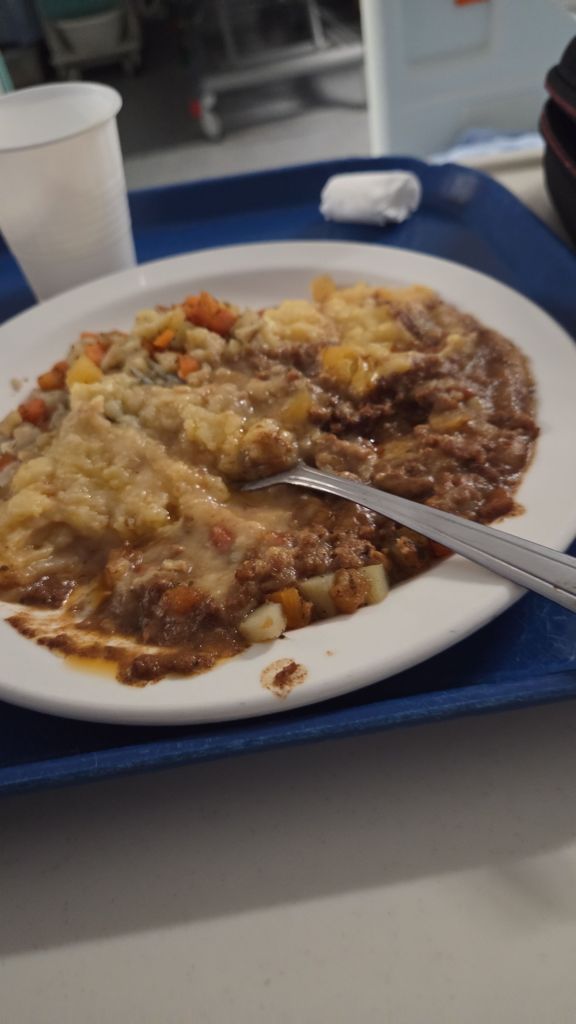
I rejected the hospital tray of slop and went to buy myself a half-decent meal from the hospital restaurant.
I was finally feeling good.
Here’s what I was told about Lidocaine.
Lidocaine works by calming down misfiring nerves. Instead of numbing a single area, like it does at the dentist, an intravenous infusion bathes the entire nervous system in it.
In simple terms, it tells overexcited pain signals to shut up. Or at least, to lower their voices.
In cases like mine, where a nerve has been irritated or damaged, those signals can keep firing very long after the original injury has taken place. Lidocaine interrupts that loop. Not permanently, but long enough for the system to reset, or at least remember how not to scream constantly.
It doesn’t cure anything.
But for a while, it gives you your life back.
The downside? Lidocaine doesn’t last. In some people it stretches to three or four months. In others, three or four weeks before the effects begin to fade.
I will need another infusion soon. And maybe another one after that.
Ad infinitum.
All we were waiting for was confirmation from the oxygen company, a tank I could temporarily use at home, in a crisis. That came through before I was even discharged.
And then it was over.
I got to go home.
I got to sleep in my own bed.
I got to see Emma and the kids.
My journey was far from over. I’ve had multiple, brutally painful attacks since leaving the hospital.
That hospital admission triggered something important though. A sequence of events that slowly set me on a path, not just towards some form of partial recovery, but towards understanding as well.
But where do we go from here?
10 Days of Pain was never about being brave or winning anything. This series doesn’t end with recovery, because that wouldn’t be true. It ends with awareness, I guess. Pain is still part of my life, but it no longer owns the entire conversation. I know what it is, how it behaves, and what helps when it turns up uninvited. That knowledge hasn’t fixed everything, but it has given me back ground I didn’t realise I’d lost.
We go forward carefully. With fewer illusions, better tools, and a clearer understanding of what this thing is, and isn’t.
There will be bad days.
There will be pauses.
But there will also be life happening in between, and I intend to keep showing up for that.
Thank you for reading.





 Mingo.Life
Leave a comment